When you buy through our links, we may earn a commission. See our Affiliate Policy.
We knew that hiking an 11.2 mile round-trip trail and gaining around 3,150 feet (960 meters) in elevation to reach the Mount Cammerer Lookout Tower in the Smoky Mountains would be a workout, but we didn’t know just how adventurous this hike would be!
After a busy and demanding year, we were in desperate need of a break. We usually spend Christmas and New Years at home, but last year we spent it exploring Manhattan and downtown New York City. While it was awesome exploring such a large city (even if New York is very dirty), the trip left us feeling burnt out months later. And we didn’t dedicate time to the outdoors to recover.

So, when nice weather coincided with the three-day Memorial Day weekend, we took a road trip to the Great Smoky Mountains! We needed some time away from people, expectations and responsibilities. We needed some time in the woods.
Planning Our Mount Cammerer Hike
With Memorial Day weekend coming up, Minerva and I decided to head into the Great Smoky Mountains again for some hiking. The park is spread across both Tennessee and North Carolina, but this time we would spend most of our time on the North Carolina side, specifically in Bryson City.
With this being our first vacation since visiting New York City, we wanted to be more in nature and not in more touristy areas like Gatlinburg.

To be honest, we haven’t been great about hiking and working out lately. Life found a way to bombard us with illnesses, work commitments and parenting responsibilities. Even getting a little extra walk in during the day felt like a luxury.
The day before, we stopped off at Kuwohi Observation Tower (formerly Clingmans Dome), but it was packed with tourists visiting during the holiday weekend. Wanting to be further out in the woods, we looked for longer, 10+ mile hikes that would give us beautiful views of the Appalachian Mountains.
While scrolling AllTrails, I found a beautiful picture of an old lookout tower at the end of the Mount Cammerer trail and just knew I had to see it in person. This would be the hike!
On another trip, we also explored the Oconaluftee River Trail, one of the only dog-friendly hikes in the Smokies.
Getting to the Low Gap Trailhead
We packed our day packs with snacks (granola and Kind bars) and safety gear, including carabiners, ropes in case one of us fell down the mountain, first aid kits and headlamps. We also filled our water bladders with liters of water (2L for Minerva and 3L for me).
Having lived in the southeast for over 10 years, we know that thunderstorms can spontaneously appear during spring and summer months (and mountain weather can make them even more spontaneous). So, we packed waterproof covers for our backpacks, too.
We had no idea that, by the end of the hike, we would be basically swimming back to the car. But more on that later.
Gatlinburg WeatherWith our bags packed and excitement building, we started the drive from Bryson City, NC towards the trailhead.

Unlike many US national parks, the Great Smoky Mountains does not charge an entrance fee. Instead, you must pick up a paid parking pass if you are parking for longer than 15 minutes. You can pick these up at the various welcome and visitor centers. Prices range from daily ($5) to weekly ($15) to annually ($40), depending on how long you’ll be visiting the park.
Any parking pass you do pick up has to be displayed and visible in your vehicle at all times. We expected the hike to the Mount Cammerer lookout tower would take around 6.5 hours, so we picked up our parking pass before arriving at the Cosby Campground.
We stayed in an Airbnb cabin on the outskirts of Bryson City, North Carolina, but the trailhead was all the way up at Cosby Campground in Tennessee, a 1-hour-and-40-minute drive away.
We woke up early and got on the road around 8:15am, planning on picking up breakfast along the way. But as we drove, we became increasingly intrigued by signs along US Highway 19 for an authentic, handmade Indian art store called Bearmeat’s Indian Den.
We later learned that the Cherokee tribe’s reservation is around Bryson City. If you have time, we highly recommend stopping in and checking them out!
We ended up eating at Donna Jo’s Market & Subway. After eating, we got back on the road, drove along Interstate 40 and through the Big Creek area, then followed Foothills Parkway before finally reaching Cosby Campground.

If you forget to pack anything, there is a Dollar General store and a camping store just next to Cosby Run along US 321 before you take Cosby Entrance Road to the Cosby Campground. We forgot bug spray and stopped at the store prior to starting our hike. And yes, the bugs were bad.
If you are not a camper, you will not be able to park at the Lower Mount Cammerer Trailhead. But you can park in the parking lot near the Low Gap Trailhead.
Once you’re on the trail, you follow Low Gap Trailhead along the Low Gap Trail to the Lower Mount Cammerer Trailhead for about 0.4 miles. However, you will not be taking this trail to the lookout tower. Instead, continue on the Low Gap Trail for 2.9 miles until you turn onto the Appalachian National Scenic Trail.
Hiking the Low Gap Trail and Appalachian Trail
Reviews on AllTrails said that this out-and-back trail would be an intense leg workout (and they were right). It starts at a modest 2,209 feet (673 meters), but climbs to around 5,000 feet (1,524 meters). The elevation gain made us think of the stairs we climbed at the Manitou Incline in Colorado (just without the stairs this time).
As soon as we stepped out of the car, we were hit with a wall of heat and humidity. You’d think with us living in the southeast, we would be used to high heat and humidity (nope!). Within minutes we had sweat just pouring down our faces, and the humidity made it very difficult for us to cool off.
Thankfully the trail is shaded which helped protect us from the hot sun.
The trail wasted no time in getting steep and it felt like we were climbing right from the trailhead. The uphill climb really doesn’t let up until around the 3.5-mile mark. According to AllTrails, the elevation ranged from 1% to 25%. This means that, in some places, for every 10 feet (~3 meters) we covered horizontally, we were gaining 2.5 feet (0.76 meters) vertically! And our calves could feel the burn!


At the start, we hiked past a small, but beautiful waterfall, which partly made us forget about the humidity. But what we couldn’t forget about was the steepness. Every turn of the trail led to more and more of the uphill climb. With the high heat, high humidity and steep incline, our heart rates were through the roof and we took numerous breaks to catch our breaths on the way up.
At the intersection of the Low Gap Trail and the Appalachian Trail, we met a hiker and their family who warned us about mud and a downed tree on the way to the tower. He told us we would need to do acrobatics to get over it (he was certainly right!).
From this junction, it’s another 2.1 miles along the AT to the lookout side trail.

Shortly after the 3.5-mile mark, the trail began to get muddier and muddier. And, just as the family said, there was a newly fallen tree blocking the path. We used our hiking poles to duck under and climb over the fallen tree without getting our feet too muddy. We hiked in May, so it’s probably been cleaned up by now.
The rest of the Appalachian Trail up to the Mount Cammerer Lookout Tower was smooth sailing! Though we were now over 4,500 feet (1,372+ meters) in elevation at mid-day, the trail was still heavily shaded.
As we hiked the last 1.5 miles to the tower, we started seeing flora, like colorful clusters of Spring Beauty and Mountain laurel, that we hadn’t seen along the rest of the trail. But it was the view from the top of Mount Cammerer that blew us away and made the entire incline hike worth it.


Reaching Mount Cammerer Lookout Tower
After a challenging ~5.5-mile incline hike (~8.85 kilometers), we finally reached the summit! We made it through the trees to an area that opened up to a small clearing with a rock ledge which gave a picturesque view of the surrounding Appalachian Mountains.
By the time we got there, there were already at least five other groups relaxing on the ledge. Approximately 200 feet (61 meters) from the rock ledge was the fire lookout tower.
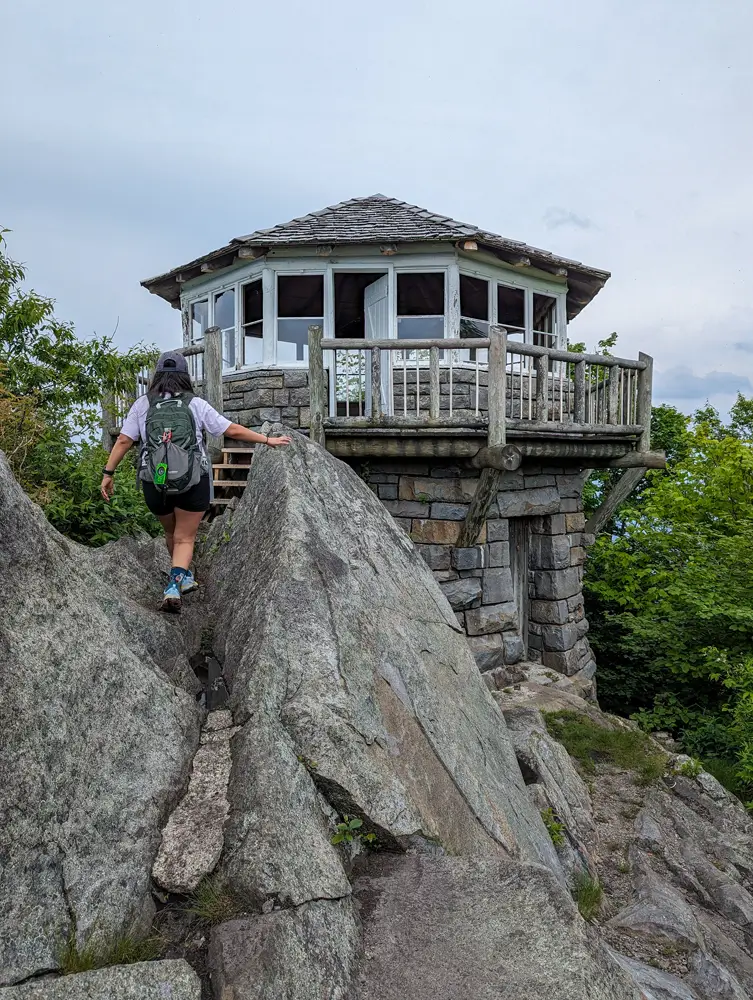
While 200 feet might not sound like a lot, in order to get to the tower, we had to navigate between sharp rocks and a muddy ground. However, once we made it through, we turned the corner and saw the lookout tower. I think the pictures speak for themselves.


All we could say was, “Wow!” The fire watch tower stood tall on the peak previously known as White Rocks, with incredible views of the Smokies in every direction.
As we climbed the rocks leading to the stairs, we got a closer look at the tower and its surroundings. Built in 1939, it remained in operation until the 1960s before being replaced by more modern smoke detection systems. It’s amazing that the tower is still standing after all these years.
As much as I loved seeing the tower, I was disappointed by the vandalism inside. I saw initials, names and dates carved into the walls, and several windows were broken or completely missing. It’s unfortunate to see a historic place like this treated with disrespect and I wish more people would take the time to respect these places.

Hiking Back Through a Thunderstorm
Once we were done enjoying the view from the summit, we turned around and began our descent back to the car. The hike back down was peaceful and uneventful which was nice after such an intense ascent.
About 2 miles from the parking lot, the sky became darker and we felt a few raindrops. We didn’t have cell reception to check the forecast, but Minerva had a feeling that a storm was rolling in. We took out our headlamps and wrapped our backpacks with our waterproof covers to protect our electronics.
Before we could put on our headlamps, it just started to pour, thunder rolled through the mountains and the wind whipped through the trees.

As the downpour intensified, the trail became a river, with water levels rising above six inches and soaking our shoes. Even though we used our hiking poles for balance, we struggled to stay on the trail or even see where the trail was under the floodwaters.
Because we couldn’t see where we were going, we followed the water downstream without really knowing where we were. We had accidentally missed our turnoff to the Low Gap Trailhead.
By the time the downpour stopped, we were soaked and disoriented, but managed to use our phones to see that we made it just outside the campground near the Mount Cammerer Trailhead.
Despite the unplanned detour, we only had a very soggy 0.4-mile hike back to the car. And, as it would figure, as soon as we reached our car, the rain stopped and the sky was blue again.
After the drive back to Bryson City, we found out the storm we encountered had formed a tornado and that the area had been under a tornado warning.
Trails End
Hiking to Mount Cammerer was a challenge, but seeing the lookout tower and the views from the summit made the climb worth it. We just didn’t expect the hike back down to turn into quite the adventure it did.
If there’s one thing we’ll remember from this hike besides the tower, it’s that mountain weather can change quickly. Even when the forecast looks good, it’s worth being prepared.
Have you hiked to Mount Cammerer Lookout Tower? We’d love to hear about your experience in the comments!
Leave a Reply